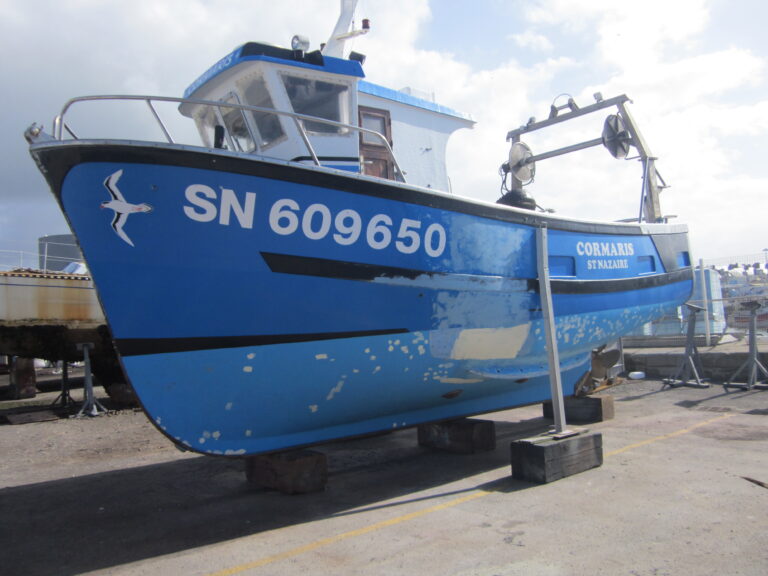



Among the most spectacular work we carry out are hull modifications: adding chines, grafting on a bulbous bow, widening, lengthening. These are major jobs, and owners often ask the same question: is it really worth it?
Chines: gaining stability without rebuilding
A chine, in this context, is a volume added to the side of the hull over all or part of its length. It widens the submerged beam and therefore directly increases the vessel’s transverse stability.
Why is it needed? Because a fishing boat gets heavier over its life, and always higher up: new winches, a reinforced gantry, electronics, life rafts, net drums. Each addition raises the center of gravity. After fifteen years, a vessel that was sound at delivery becomes tender, uncomfortable and sometimes borderline against stability criteria.
Chines solve this problem without touching the deck or the interior. The gain is immediate: less rolling, a safer working platform and restored margin in the stability file.
The bulbous bow: comfort and efficiency
The bulb works differently. Placed below the waterline at the bow, it changes the wave pattern generated by the hull. Two effects follow.
The first is reduced pitching. On a vessel that steams into the sea for several hours per trip, the crew feels the difference immediately. Less pitching means less fatigue, fewer breakages on board and the ability to hold speed in bad weather.
The second is a gain in propulsive efficiency within a given speed range. It is not spectacular — nobody will gain two knots — but over a year of operation, the drop in fuel consumption is measurable.
How we work at the yard
These modifications cannot be improvised. They start with a study, carried out with a naval architect, which validates the added shapes, recalculates stability and prepares the regulatory file.
Then comes the workshop. We build the volumes in composite, then graft them onto the existing hull. The decisive technical point is the joint: it must be structural, not just watertight. We grind back the original hull, cut a progressive scarf and laminate a bond that restores mechanical continuity between old and new.
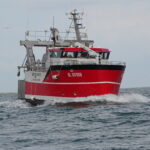
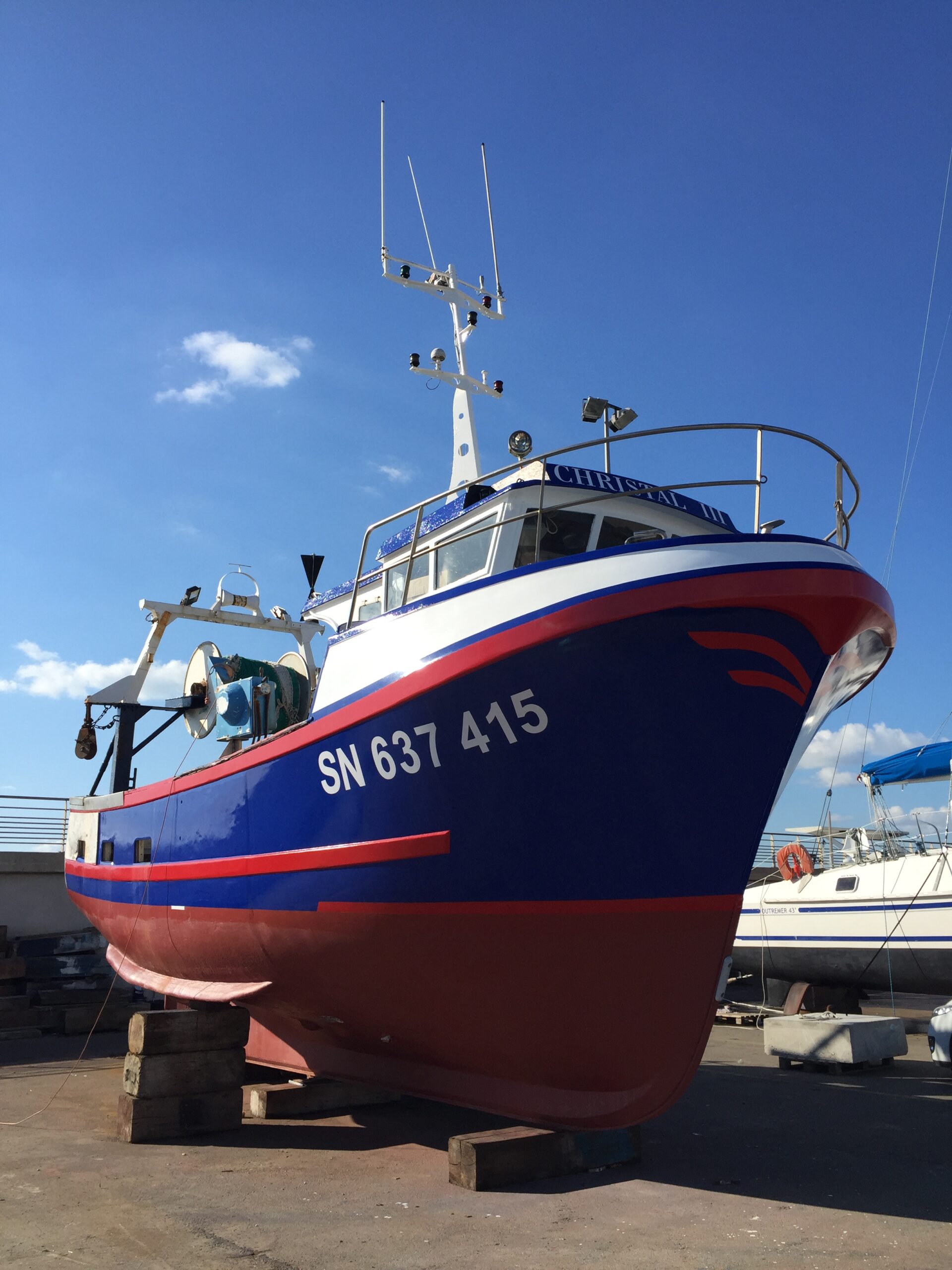
The finish matters just as much. On the vessels we have worked on — Cristal III or La Capricieuse, for example — the bow and transom joints were faired and then refinished in gelcoat. An untrained eye cannot tell the vessel has been modified.
The economic trade-off
A hull modification costs a fraction of a new build. It can extend the working life of a structurally sound vessel by ten to fifteen years and adapt it to a fishing method that has changed.
It is a long-standing specialty of Plasti Pêche, and one of the reasons owners from Brittany, Normandy and northern France entrust us with their vessels.